
Compare AI models: which one earns its keep?

You find a model near the top of a leaderboard. It sounds impressive.
Then you ask it to plan an event with three volunteers, four tables and a small budget, and discover that the spreadsheet wasn’t the hard part. Finding someone to welcome the guests was.
That gap is familiar to anyone who has tried using AI for real work. A model can be good at difficult tests and still make an assumption you would never make. Another can produce a less polished answer that catches the detail you care about.
Benchmarks help us decide which models deserve a look. A task we understand helps us decide which answer deserves our trust.
MindsHub lets you give the same task to two AI models and compare their answers, total time and estimated cost. You bring the judgment about whether the result is useful. The side-by-side view gives you a common starting point and a place to see the differences.
We tried it with a fictional repair café. No personal documents, no mysterious exam questions, and no toaster was harmed in the evaluation.
One task, two models, the same workspace
MindsHub brings multiple models into one service. MindsHub Agents is the agent workspace, where models can work with your instructions, files and tools. MindsHub Inference is the API for using models in your own applications.
In MindsHub Agents, choose Compare Models from the navigation to open the side-by-side view. You can select two models and give them one task. If you attach files, each side works on its own copy. The interface keeps publishing and messaging actions on hold until you continue with one side.
This is a comparison inside MindsHub’s agent environment. It is not a claim about how those models behave in every other app. The surrounding software, called a harness, also affects the work. Here we keep that environment in common while changing the model.
Our model board can help narrow the candidates using an intelligence estimate, response times and task-cost measurements. Trying them side by side answers a more personal question: what happens when these candidates meet your problem?
The task: a café with more guests than helping hands
We chose GPT-6.1 Sol and Claude Sonnet 5.5, then entered the same fictional brief for both. The task is ordinary enough to understand, but it contains a few useful tensions: setup overlaps with opening time, a volunteer arrives late, and four tables do not magically create a fourth volunteer.
Here is the full prompt, if you would like to try a version of it:
Plan a neighbourhood repair café for 24 guests. We have 3 volunteers, 2 hours, 4 work tables and a $120 budget. Doors open at 10am; one volunteer arrives at 10:30. Allow 15 minutes for setup and 15 minutes for cleanup within those 2 hours. Supplies cost $55, drinks cost $1.50 per guest, and we want a $20 reserve. Write a short, workable plan with a timed schedule, budget arithmetic and the biggest bottleneck. If a constraint cannot be met, say so rather than quietly changing it. Finish with one cheerful invitation line. Use only these fictional facts; no web browsing or connected apps.
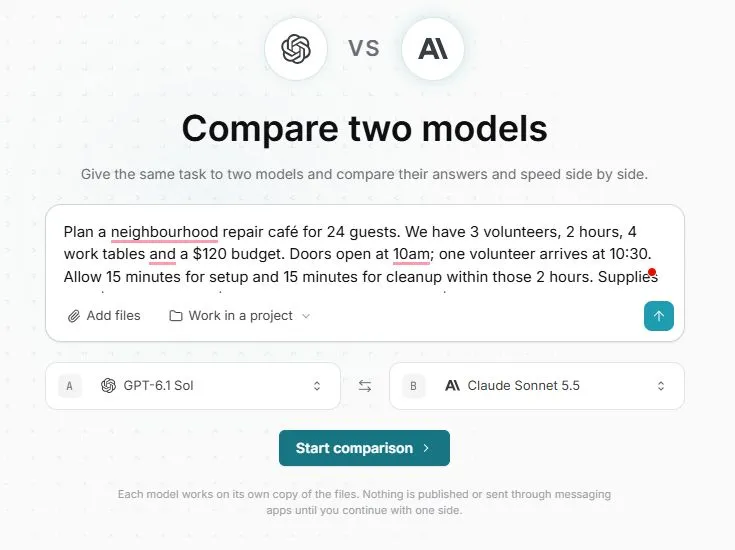
One brief, two selected models. This example uses fictional facts and no attachments.
The screen has a place for the task, optional files and the two model choices. Start comparison sends them off. Their work appears in separate panels, so one model’s answer doesn’t become the other’s starting material.
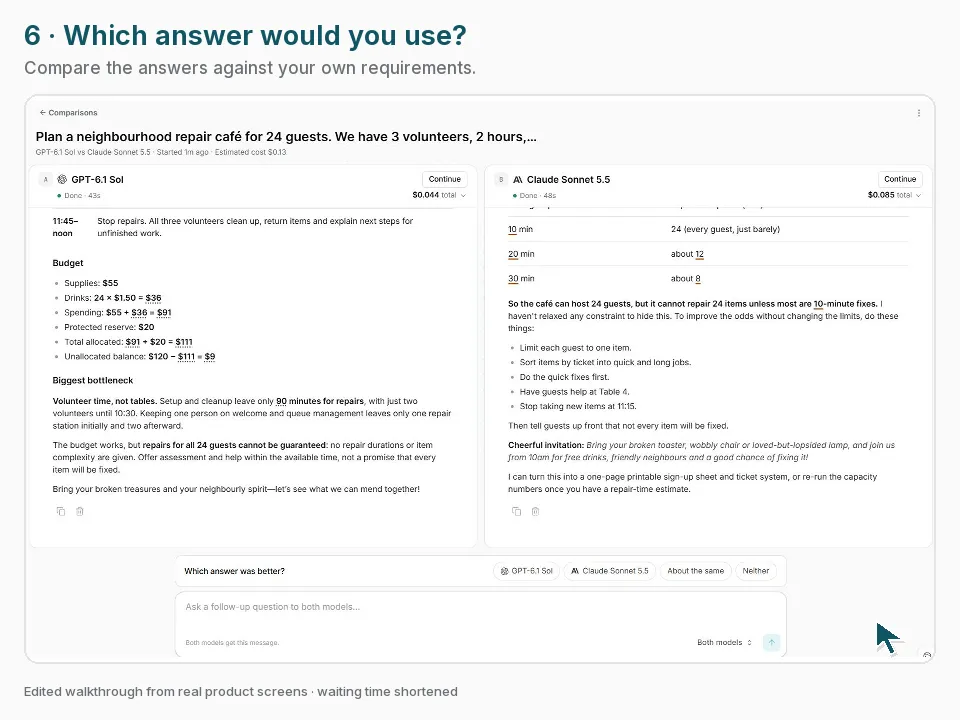
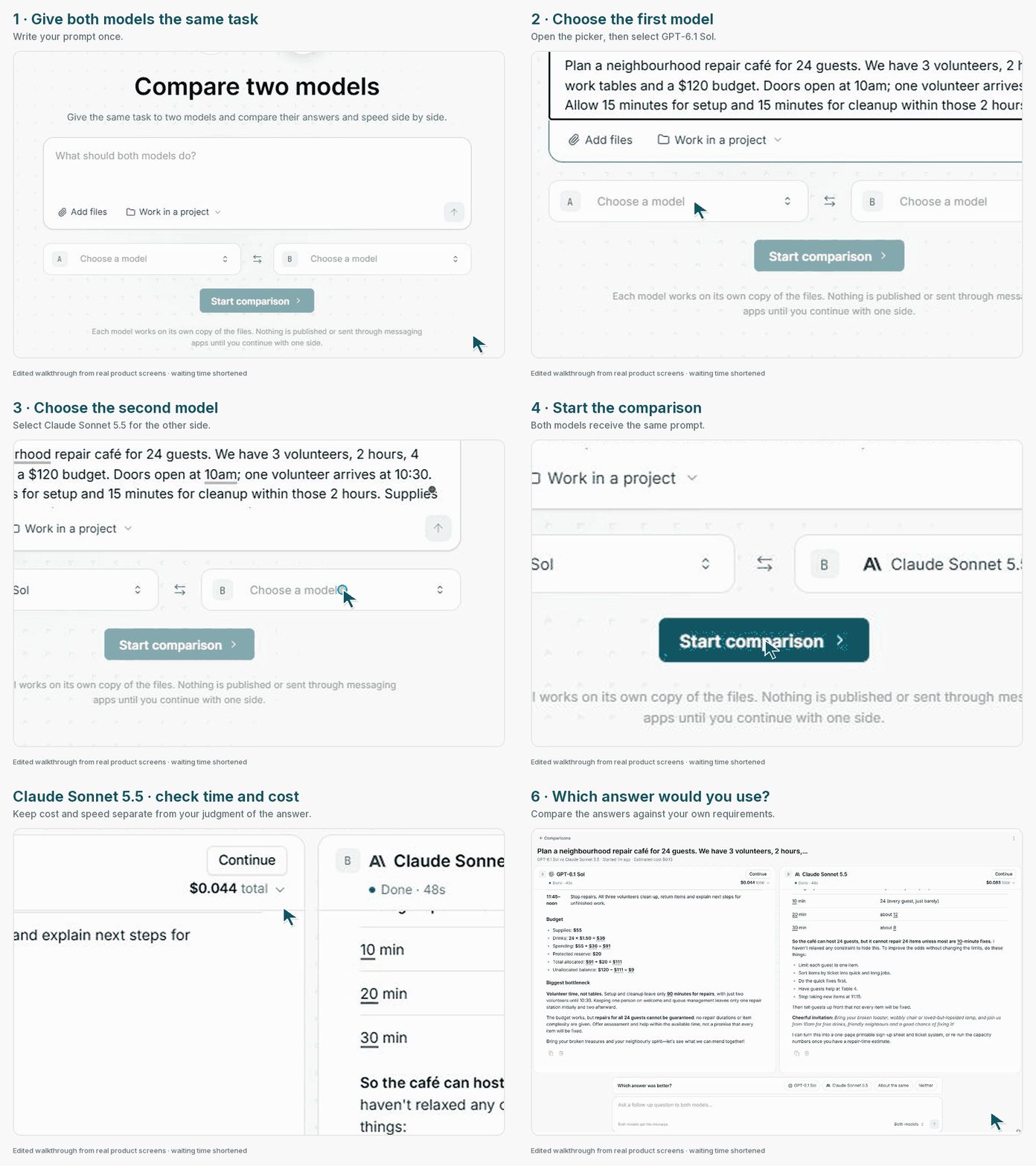
There is a small pleasure in watching both tackle the same problem. It is a race, but crossing the finish line first is only part of the result. A fast plan that needs a fourth volunteer has invented a very unhelpful volunteer.
What the two answers revealed
Both models worked out the budget: $91 in spending, a $20 reserve and $9 left unallocated. Both recognized that volunteer time would constrain the event and that nobody could promise 24 successful repairs without knowing how difficult the items were.
Their plans differed in ways a general intelligence score would not show.
GPT-6.1 Sol kept one volunteer on welcome and queue management. That left fewer repair stations, but gave the arriving guests someone to talk to. Claude Sonnet 5.5 devoted more people to repairs and calculated a theoretical capacity of 255 volunteer-minutes, while acknowledging that this assumed everyone did nothing except repair. It also noticed that the drinks allowance covered guests, not volunteers.
That extra arithmetic was helpful, but it deserved a human look. The theoretical capacity did not deduct the two-minute briefing in Claude’s own schedule. Neither answer knew the repair mix. These are the sorts of details that matter when the plan is going to leave the screen and meet a room full of people holding broken lamps.
For our purposes, GPT’s allocation made the welcome desk easier to imagine. Someone organizing a more self-service event might prefer Claude’s extra capacity analysis. The point is that the difference is visible and discussable. You don’t have to accept a winner chosen by a score you cannot inspect.
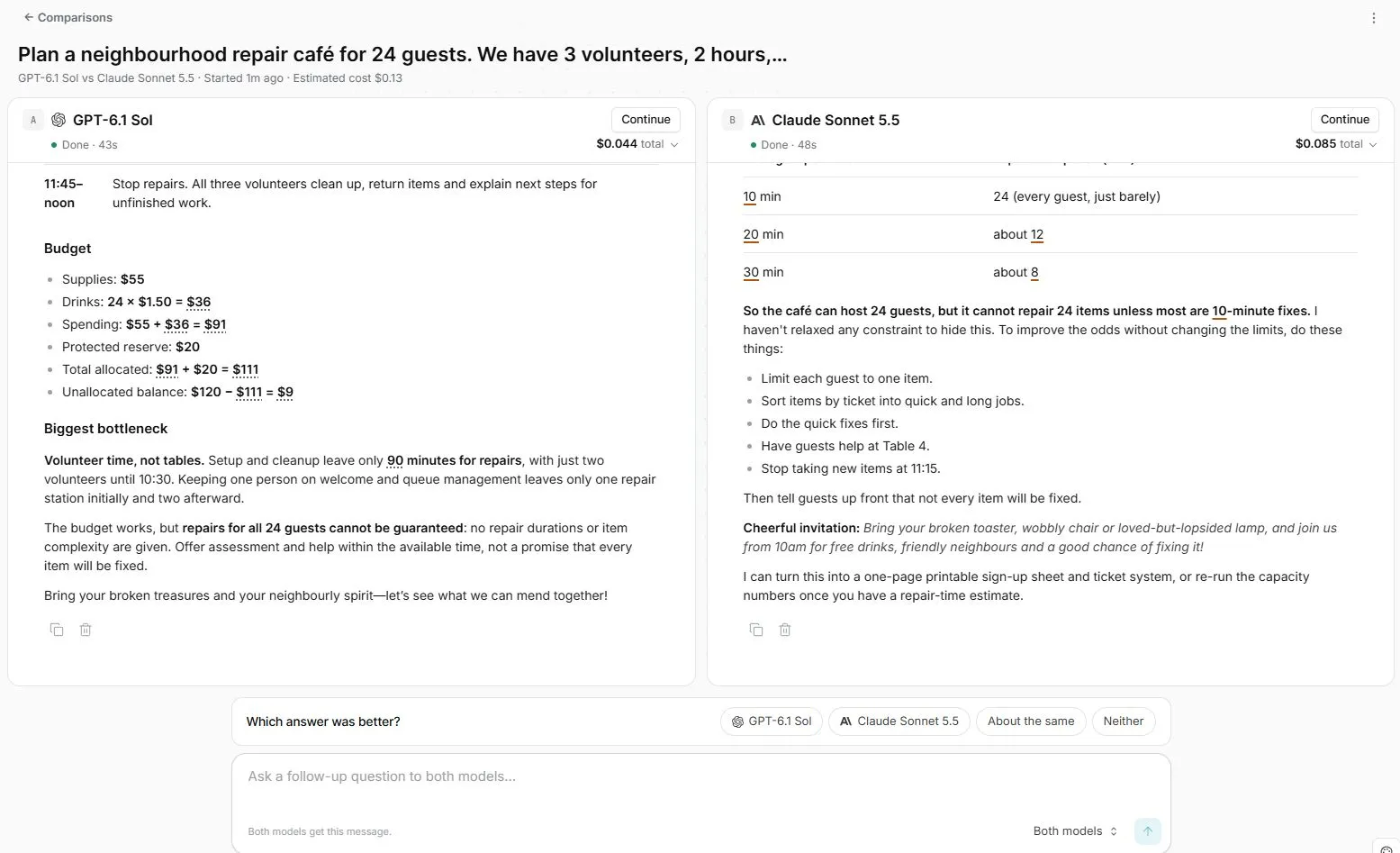
Actual example from November 13, 2026. The account sidebar is excluded; all task details are fictional. Select any screenshot for a larger view.
The stopwatch and the bill tell another part of the story
The headers show the total elapsed time and estimated cost for each side. In this run:
| Model | Total time shown | Estimated cost shown |
|---|---|---|
| GPT-6.1 Sol | 43 seconds | $0.044 |
| Claude Sonnet 5.5 | 48 seconds | $0.085 |

These are the interface’s list-price estimates for this one run, including the agent’s own calls. They are not universal model prices or a repeatability claim.
GPT was quicker and less expensive here. That is useful information about this attempt, not proof that it wins every planning task. A repeated run can vary, and another task may reward a different style of analysis.
The three questions can stay separate: Which output would I use? How long did I wait? What did it cost? A model doesn’t need to win all three to be the right choice for you.
When both sides finish, the interface offers choices for the better answer, including About the same and Neither. Both are legitimate results. You can send a follow-up to both models or continue with one side. For this café, a useful next question might be how the plan changes if half the repairs take 20 minutes.
Six races worth trying
The most revealing contest is usually a task you care enough about to notice a bad answer. A little ambition makes it more fun.
- The spreadsheet detective. Give both models a fictional expense sheet with a duplicate invoice, a missing category and a total that is almost right. Who finds the gremlins without accusing the coffee budget of fraud?
- The impossible weekend. Ask for a two-day trip with a fixed budget, a nap-loving child and one person who hates queues. Supply the opening hours yourself. Who notices the closed museum before sending the family there?
- The tiny-game championship. Ask for a playable browser game with one surprising mechanic and no external assets. Which one works, explains its controls and survives your attempt to break it?
- The explanation duel. Give both the same public research paper and ask for an explanation for a curious teenager. Which makes the idea clear while admitting what the paper does not establish? Bonus points for an analogy that survives scrutiny.
- The meeting archaeologist. Provide messy fictional notes with a reversed decision and an unnamed action owner. Which model recovers the decisions without confidently assigning work to someone who never volunteered?
- The pitch rescue. Ask each model to turn a vague product idea into a one-page pitch, then list the three reasons it might fail. Which is imaginative and willing to interrupt its own sales speech?
These can reveal different strengths: careful arithmetic, constraint tracking, working code, clear explanations, uncertainty and useful criticism. A model that wins your game contest may not be the one you want checking an invoice.
Your task has the deciding vote
A side-by-side comparison is a small experiment. It becomes more persuasive when several representative tasks show the same pattern. One charming answer is a reason to explore, not a lifetime appointment.
For a consequential workflow, known expected results and repeat runs give a firmer basis than a single preference. For a personal draft, you might simply care which version gets you closer to done. Both uses are reasonable, as long as the conclusion matches the evidence.
If you have two models in mind, you can give them the same task in MindsHub Agents. If you are still choosing candidates, the live model board and our guide to model intelligence can help.
The leaderboard can introduce the contestants. You get to decide what counts as winning.
Frequently asked questions
How can I compare two models in MindsHub?
In MindsHub Agents, open Compare Models from the navigation. Choose two models and give them the same task. Their work appears side by side with total time and estimated cost, so you can judge the outputs, follow up or continue with one side.
Does the cheaper or faster answer automatically win?
No. The result still needs to meet your needs. Time and cost make the tradeoff visible; they do not establish correctness, usefulness or quality.
Is one comparison enough to choose a model?
One comparison can reveal useful differences. Several representative tasks and repeat runs provide stronger evidence, especially for workflows where errors matter. The result also reflects MindsHub’s agent environment, not just the model in isolation.