
How to choose an LLM without the hype

Imagine your weekly report is finally working. The AI reads the notes, finds the relevant figures, and gives you a draft you can use. Then a better model arrives.
It scores higher. It costs less. Replacing the model name takes a moment.
The next report is beautifully written. It also changes the format your spreadsheet expects and treats a tentative sales estimate as confirmed revenue. You spend the afternoon discovering which parts of “better” apply to your work.
The spreadsheet, unfortunately, has not read the glowing release announcement.
This is a hypothetical example, but it points to a frustrating question: how do you choose an LLM when the most impressive model might create more work for you?
A useful answer has to cover more than intelligence. It includes how the model behaves inside your application, how long you wait, what usable results cost, and how much trouble the next change might bring.
Changing the name is the easy part
A shared API can make several models available through the same interface. That is helpful. It doesn’t make their behavior identical.
In VentureBeat’s October 2026 survey, 70% of respondents reporting production swaps described weeks or more of extra engineering. That limited sample cannot predict your timeline.
There is a smaller, everyday version of the problem in our imaginary report. Perhaps the instructions assumed the model would leave uncertain figures alone. Perhaps a tool’s description made sense to the previous model but is ambiguous to the replacement. The application has expectations that aren’t captured by a model name.
That helps explain why a promising replacement can deserve a trial without deserving an immediate rollout. A few familiar reports, especially the awkward ones, may reveal more about the decision than another afternoon comparing overall scores.
The model is part of the system
The terminology can make this harder than it needs to be. A model produces responses and can propose tool calls. An agent uses a model to work through a task. The harness is the surrounding software that manages the process: passing information, running tools, and deciding what happens next.
Tools give that system abilities such as searching files or querying a database. Context is the material available to the model at a particular moment, including instructions, documents, and previous messages. Anthropic’s context-engineering guide explains why selecting that material is an ongoing part of building useful agents.
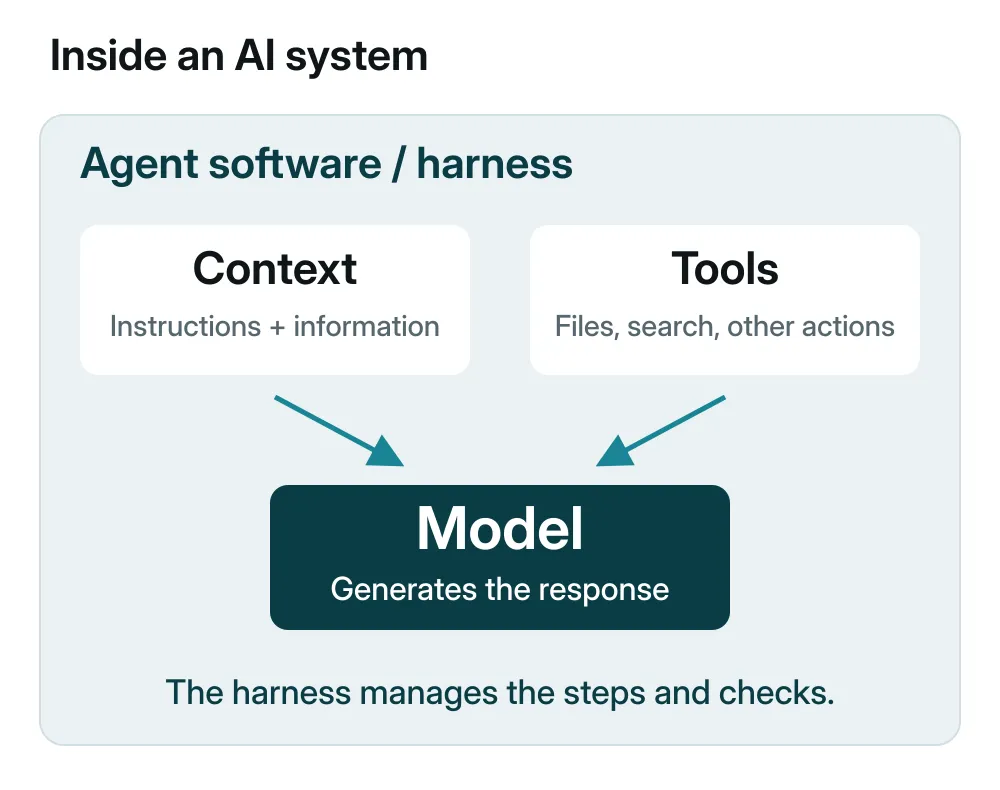
The distinction has practical consequences. In Arena’s HarnessTax study, the same model could achieve similar success rates at different costs in different harnesses. The study tested 21 combinations on small samples from two coding benchmarks, so it establishes a reason to examine the pairing, not a universal best harness.
For our report, a model cannot verify figures in a document it never receives or query a database through a tool it doesn’t have. Replacing it may help with interpretation, but it won’t supply those missing pieces.
This article focuses on choosing the model. We plan to explore agents, harnesses, tools, and context in future posts. They deserve their own space, rather than a footnote claiming the model choice settles everything.
Benchmarks are useful clues, with different meanings
Nobody has time to try every model. Public evaluations help narrow the field, provided we know what each one is telling us.
Three useful perspectives are:
- Artificial Analysis combines evaluations across areas such as coding, knowledge work, and science. Its intelligence index gives a broad comparison, but the mix and weighting may differ from your work.
- Epoch AI’s Capabilities Index combines benchmark results into a general-capability scale. It helps compare models across tests; Epoch notes that a specialist can score lower overall while being strong in its own domain.
- Arena uses people’s choices between anonymous model responses. That adds a useful view of what readers prefer. Preference also reflects presentation: Arena’s own style analysis found that answer length and formatting can affect rankings.
None of these is a reason to dismiss benchmarks. They answer different questions. A strong general score can suggest that a model deserves a closer look; an answer your reviewer likes can reveal something a multiple-choice test misses.
Back at the weekly report, the important detail is mundane: does the model preserve the distinction between estimated and confirmed revenue? A broad score can’t answer that specific question on its own.
The tradeoffs appear in ordinary work
Suppose two models produce reports you would be comfortable sharing. One finishes quickly. The other takes longer but costs less. For a report prepared overnight, the slower option might suit you perfectly. During a live meeting, the pause could matter much more.
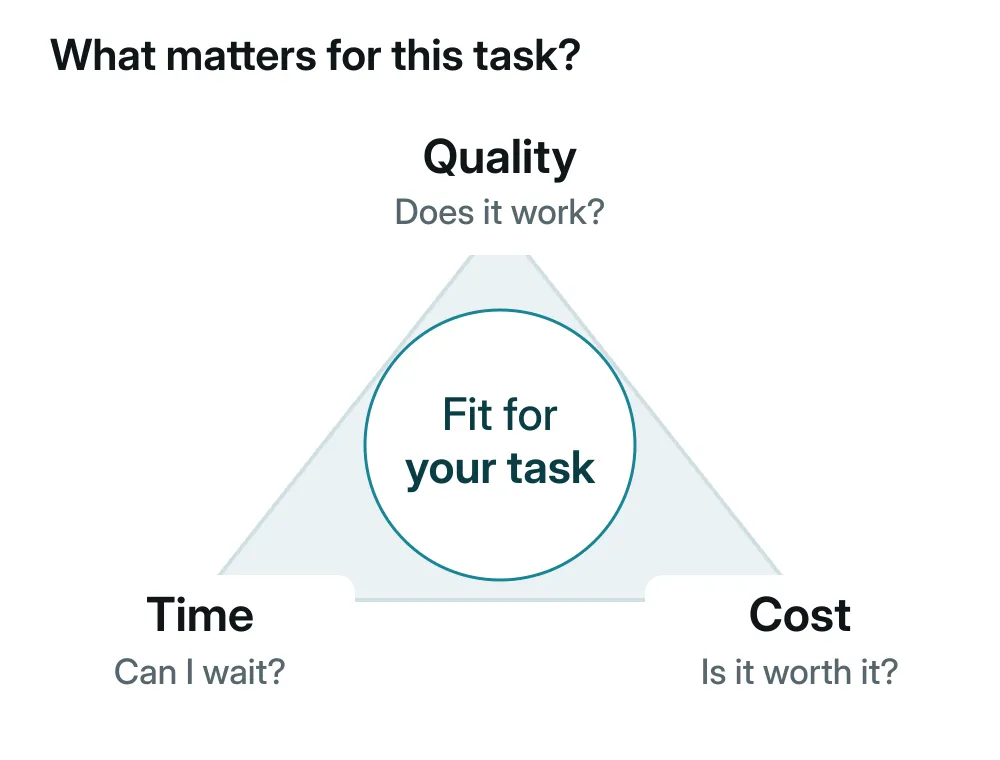
Even “fast” needs a little explanation. Some models wait before producing visible text, then write quickly. Others start sooner but finish later. The time until an answer begins and the time until the whole answer is ready describe different experiences.
Cost has a similar wrinkle. Tokens are pieces of text the model reads or generates. Their unit price is useful, but a longer response or another attempt can change the bill. For this report, the relevant expense includes the drafts you reject and the time spent correcting the one you keep. Our cost-per-task article explores that difference.
There are also conditions a score cannot negotiate. A model needs to accept the inputs your task uses, and its service needs to fit your data-handling and operating requirements. A high score is little comfort if the model cannot read the files you need.
Where MindsHub’s measurements fit
This is the part we can help make more visible. MindsHub provides access to multiple models through the MindsHub Inference API. Our live model board brings together measurements of models served through that service.
We run our own checks for response times and availability, and repeated writing tasks to measure speed and token use. The dollar task-cost estimates apply current standard rates to measured token counts, excluding cache discounts. These measurements describe our service under the stated test conditions; another route or a different task can behave differently.
Intelligence is separate. MindsHub’s read is our subjective 1–10 estimate informed by public benchmarks and rankings. We don’t measure answer quality with our speed tests, and the estimate isn’t a promise about your report. We hope it offers a readable starting point alongside the practical measurements.
The Intelligence view keeps that estimate separate from Performance and Cost per task. The leaderboard puts the categories together for anyone who wants to explore the current models. Our best LLMs guide gives the longer explanation of those comparisons.
A choice that leaves room to change
Our imaginary report doesn’t need to win a benchmark. It needs to arrive with the right figures, in a usable form, at an acceptable cost.
You may find that the newer model does that better. You may find that a smaller one is enough, or that keeping the current model makes sense while another part of the application improves. Those are all reasonable outcomes.
Keeping a few representative examples and their expected results makes the next decision less mysterious. The comparison becomes about changes you can see in familiar work, with the public scores helping you choose where to look.
If that sounds useful, the live models page is a place to begin exploring. The final choice belongs with the person who knows what a good result needs to do.
Frequently asked questions
How do I choose an LLM for my application?
A useful choice balances acceptable answers, response time, cost, and operating requirements. Public benchmarks can narrow the candidates; familiar examples from the application show whether those strengths carry over to its actual work.
Why can a better-ranked model perform worse in my app?
The ranking measures particular tasks and settings. Your application supplies its own instructions, context, tools, and constraints. A model that performs well on the benchmark may respond differently to that combination.
What is the difference between an LLM and an agent?
An LLM is the model producing responses. An agent uses a model within a process for working through tasks, with surrounding software managing context, tools, and execution. The model’s capability is one part of the system’s performance.
Does MindsHub measure model intelligence itself?
MindsHub’s intelligence rating is a subjective 1–10 estimate informed by public benchmarks and rankings. It is separate from our direct measurements of response times, availability, and token usage. Our writing tests do not grade answer quality.
Should I change models whenever a new one leads a benchmark?
A new leader offers a reason to investigate, rather than an obligation to switch. A change is more persuasive when it improves results, waiting time, or total cost on work you actually need done.